
 By
By IRAC Method vs. PEEL Method for Law Assignments
As a law student, you will have to submit a lot of assignments in your academic journey. However, the major challenges you will face in law assignment writing are how to structure and organise the paragraphs, how to start with the assignment, what the IRAC method is, and what the PEEL method is.
If you are overwhelmed by the names of these methods and don’t understand how to utilise these methods yourself, then this blog will guide you.
Structure and organisation of the ideas are non-negotiable in law assignments. You may possess strong legal knowledge and have an in-depth understanding of the legal case or legal principles, but if your assignment doesn’t have clarity or coherence, your grades will suffer. If you don’t want to lose marks, then you can utilise the IRAC or the PEEL method.
Moreover, these methods differ in terms of purpose. However, using the IRAC or PEEL method will help you elevate the quality of your assignment. Let’s begin!
What is the IRAC Method?
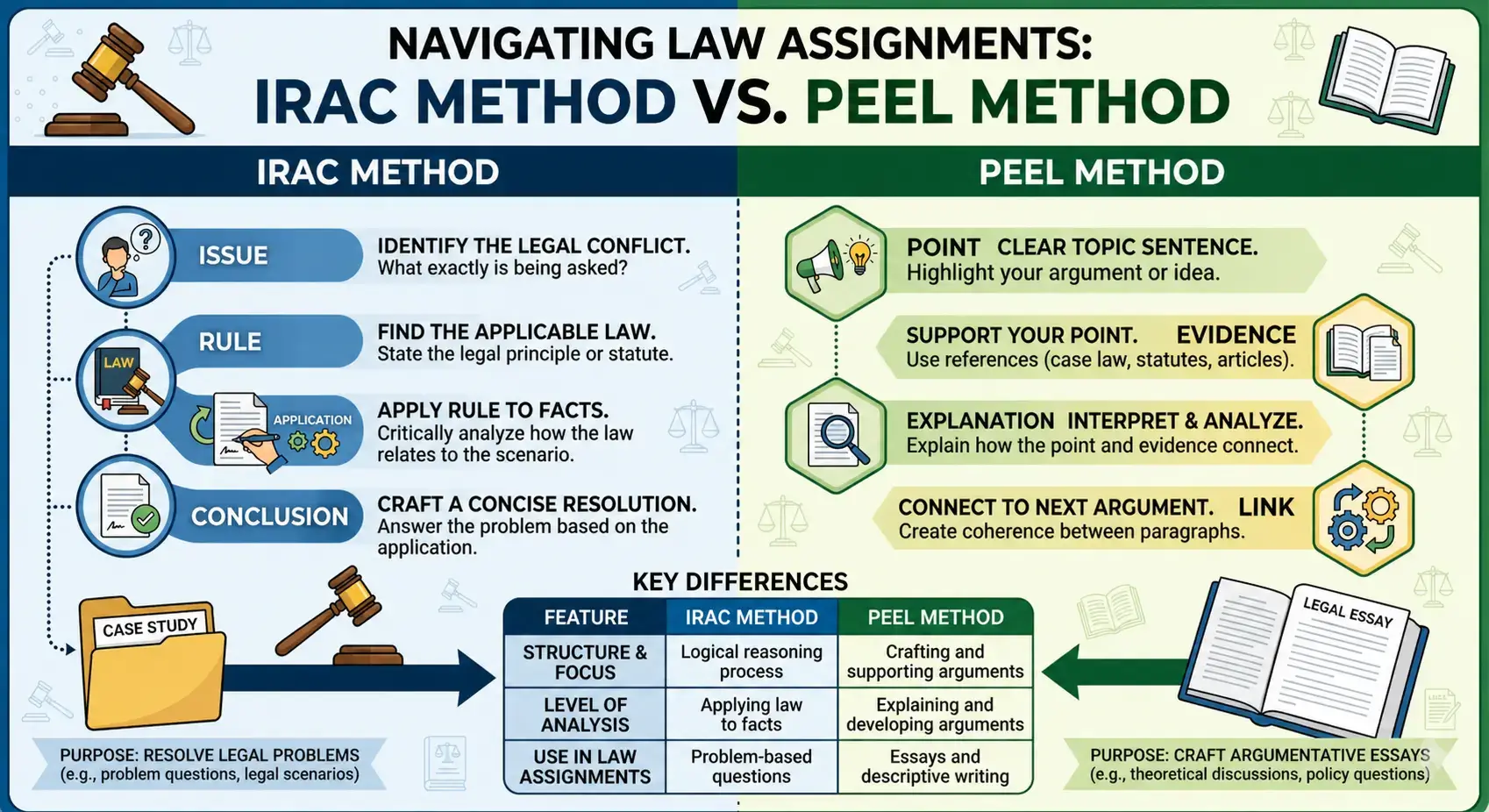
IRAC stands for issue, rule, application, and conclusion. It is one of the methods that you can use to answer problem-based law questions. This method will help you break the question into components and structure your answer coherently. It serves as the foundation of legal analysis.
In addition, this method also helps students to think critically and look into aspects that they might otherwise not.
Understanding the IRAC format:
1. Issue:
The first step is to identify the issue in the problem scenario. Many students struggle in this step, which makes their answer irrelevant and inaccurate. Consider these questions: what exactly is being asked, and what legal conflict needs to be resolved?
2. Rule:
The second step is to find a specific legal rule or principle applicable to the legal issue. This process involves conducting in-depth research using study materials to find the right cases or statute sections that will assist in answering the legal issue.
However, if you are unable to identify the relevant rule, then you may reach an inaccurate conclusion. Plus, identifying the correct rule or principle will help reflect your understanding and add credibility to your argument.
3. Application:
It is the most important section of your answer, as you have to apply the rule to the specific facts of the problem. This section requires critical thinking and analytical depth. You can also use the cases you identified in the second step to compare and contrast the facts in those cases with the facts in the problem question.
4. Conclusion:
This is the last step of the IRAC method in which you have to craft a concise conclusion based on your application. Moreover, the conclusion must directly address the question.
What is the PEEL Method?
If you struggle to add coherence and links between sentences in your law assignments, then it’s a sign that you must utilise the PEEL method. However, the method is used to craft the body paragraphs and not the entire answer. If you are assigned an essay or argumentative legal writing, then you must use this method.
The major difference between the IRAC and PEEL methods is that, unlike the IRAC method, the PEEL method is not limited to the field of law. You can use this method in essays belonging to any field. PEEL stands for point, explanation, evidence, and link.
Point:
It involves starting with a clear topic sentence that clearly highlights your argument or idea.
Evidence:
The next step is to support your point with a reference by using case law, statutes, journal articles or books.
Explanation:
This step involves explaining how the point connects with evidence. You have to provide interpretation and analysis. Add the implications, inconsistencies, and potential reforms etc.
Link:
Lastly, link your point to the next paragraph or the major argument.
IRAC Method vs PEEL Method:
Both of these methods aim to improve the clarity and coherence of law assignments, but their purposes are different. However, if you struggle with any of the methods, you can connect with law assignment help.
1. Purpose:
IRAC Method: It aims to resolve legal problems.
PEEL Method: It is used for argumentative and descriptive essays.
When you are assigned an assignment, read the topic and determine if it involves analysing the legal scenario, then you should choose the IRAC method. However, if you have to discuss the legal principles, then use the PEEL method.
2. Structure and Focus:
IRAC Method: It focuses on the logical legal reasoning process.
PEEL Method: It focuses on crafting and supporting the arguments.
3. Level of Analysis:
IRAC Method: This method requires students to apply the law to facts.
PEEL Method: It requires students to explain and develop arguments.
4. Use in Law Assignments:
IRAC Method: You must use the IRAC method for the problem-based questions, case analysis, and legal scenarios.
PEEL Method: You can use the PEEL method for essays, theoretical discussions, and policy-based questions.
When Should You Use the IRAC Method?
If your law assignment asks you to advise a client, resolve a legal problem, or analyse a problem-based scenario, then use the IRAC method.
For example, a contract law question that involves breach and remedies.
Without the IRAC method, you will not be able to organise your thoughts or analyse a scenario.
When should you use the PEEL method?
If your law assignment is based on essay-type questions, such as discuss the importance…, evaluate the role of …., then use the PEEL method.
It assists in argument development and ensures that your points are evidence-based.
How to Master the IRAC and PEEL Method?
- You must practice with past papers.
- Use headings and subheadings.
- Focus on clarity over complexity.
- You must learn the key cases for strong legal knowledge.
All in All!
In law assignments, you must identify which method is appropriate for the task. For problem-based questions, go for the IRAC method, and for essay-based questions, go for the PEEL method.
Law assignments not only assess your knowledge but also how well you can communicate your ideas. In that regard, the IRAC and PEEL methods will assist you in securing top grades.